Choosing the Right LED Flameless Candle Manufacturer: What Buyers Actually Need to Know
Not all LED flameless candle manufacturers are equal — and the difference shows up not just in price, but in product lifespan, battery performance, wax finish quality, and the ability to meet custom orders at scale. For hospitality businesses, retailers, and event suppliers sourcing flameless pillar candles in volume, partnering with a capable factory from the start saves months of rework and thousands in returned goods. This article breaks down what separates serious manufacturers from assemblers, what rechargeable flameless candles actually offer over battery-only models, and what a qualified flameless pillar candles factory should be able to demonstrate before you place your first order.
The Global Market for Flameless Candles Is Growing — and Getting More Competitive
The global flameless candle market was valued at approximately USD 412 million in 2023 and is projected to reach over USD 680 million by 2030, growing at a CAGR of around 7.3% (Grand View Research). This growth is driven by expanding hospitality infrastructure, fire-code compliance requirements in commercial spaces, and rising consumer preference for safe home décor alternatives.
China remains the dominant production hub, accounting for an estimated 65–70% of global flameless candle manufacturing output, with major clusters in Guangdong, Zhejiang, and Fujian provinces. However, buyers who treat all Chinese manufacturers as interchangeable quickly discover quality variance that can span from hotel-grade premium to cheaply assembled novelty items.
Understanding what drives these differences — LED chip quality, wax composition, circuit board design, and rechargeable cell specifications — is the foundation of smart sourcing.
Rechargeable Flameless Candles vs. Battery-Operated: A Real Cost Comparison
One of the most significant product decisions buyers face is whether to source rechargeable flameless candles or battery-operated units. The upfront price difference is real — rechargeable models typically cost 30–55% more per unit at factory price — but the total cost of ownership tells a very different story for commercial users.
Cost comparison over 24 months for a hotel with 200 flameless pillar candles in use daily
| Cost Factor |
Battery-Operated Model |
Rechargeable Model |
| Unit cost (factory, MOQ 500) |
$3.80–$5.50 |
$6.20–$9.00 |
| Battery replacement (24 months) |
~$2,880 (AA batteries ×3, every 4–6 wks) |
$0 (built-in Li-ion cell) |
| Staff labor for battery changes |
Significant (8–10 hrs/month) |
Minimal (plug-in charging) |
| Waste disposal (batteries) |
High (regulatory cost in EU, CA) |
Negligible |
| Estimated 24-month total (200 units) |
~$4,640+ |
~$2,200 |
For any hospitality or event operation running flameless candles at scale, rechargeable units break even within 6–9 months and generate significant savings beyond that window. The calculation shifts further in favor of rechargeable models when you factor in EU battery disposal regulations and California's AB 1905 requirements for battery waste management.
What to Check in a Rechargeable Flameless Candle's Battery Specs
Not all rechargeable cells are equivalent. When evaluating manufacturers, request the following battery specifications in writing:
- Cell chemistry: Li-ion or LiPo (preferred over NiMH for weight and cycle life)
- Cycle life rating: a quality cell should sustain 500+ charge cycles before dropping below 80% capacity
- Charging input: USB-C is increasingly standard; micro-USB is acceptable but aging
- Charge time and runtime: a 4–6 hour charge should yield at least 10–15 hours of runtime
- Overcharge/over-discharge protection circuit (PCB): essential for safe operation
Manufacturers who cannot provide these specs on request — or who provide only vague answers like "long battery life" — are a red flag.
What a Qualified Flameless Pillar Candles Factory Can Actually Produce
The term "factory" is loosely applied in the flameless candle supply chain. Many exporters operating as factories are in practice trading companies that outsource production to third-party workshops. This is not inherently disqualifying, but it creates quality control gaps that matter at scale. Here is how to tell the difference.
Signs of a Genuine Manufacturing Facility
- In-house wax pouring or injection molding: Pillar candle aesthetics depend heavily on wax composition and surface finish. A real factory controls this process; a trader buys pre-finished shells.
- LED assembly line: Soldering, PCB integration, and flicker circuit tuning should happen on-site for quality consistency.
- QC sampling documentation: Ask for AQL (Acceptable Quality Level) inspection records. A standard AQL 2.5 protocol means approximately 2 units per 100 are inspected; AQL 1.0 is more rigorous and appropriate for hospitality-grade products.
- Certifications relevant to target markets: CE and RoHS for European Union; FCC and California Prop 65 compliance for the US; KC Mark for South Korea. A factory exporting to these markets without these certifications is operating outside compliance.
- MOQ flexibility: Established factories typically set MOQs at 500–1,000 units per SKU for standard items and 1,000–3,000 for custom designs. Very low MOQs (under 100 units) often indicate a trader, not a manufacturer.
Pillar Candle-Specific Manufacturing Considerations
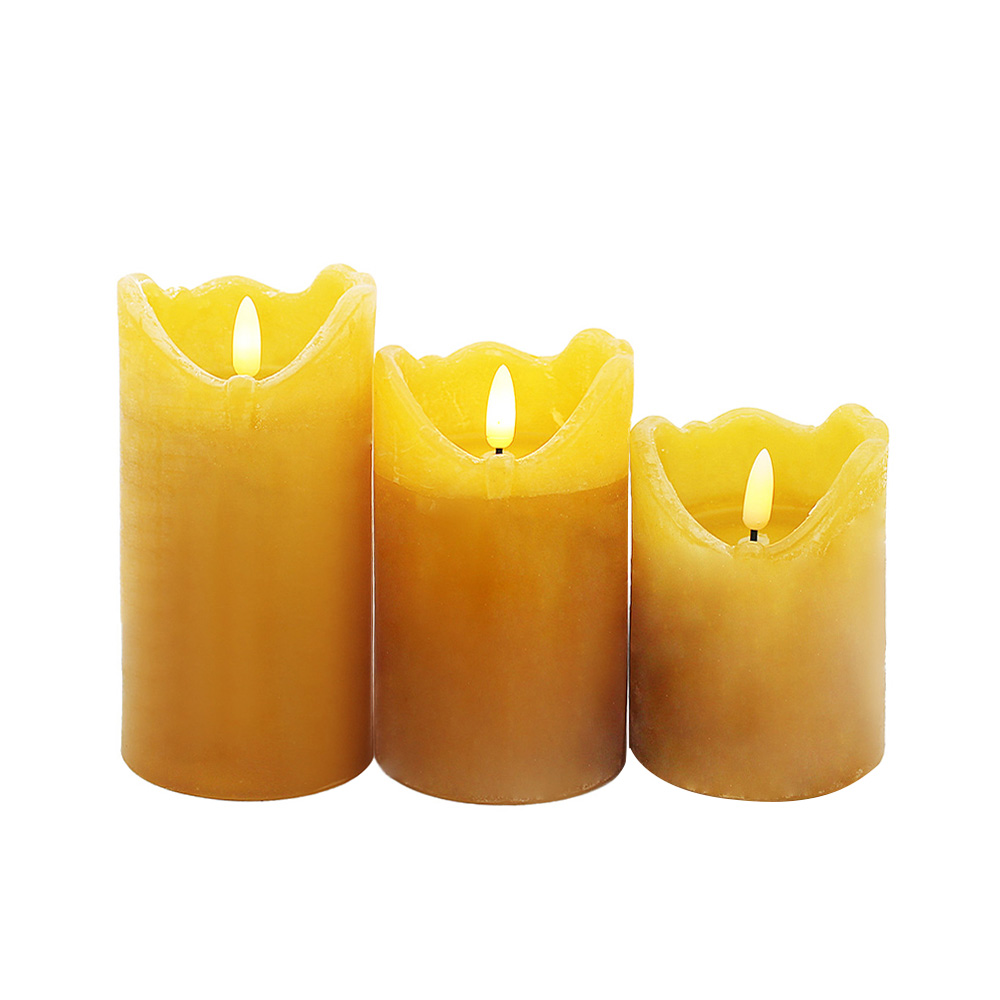
Flameless pillar candles have unique production requirements compared to taper or votive styles. The hollow wax shell must be structurally stable, the LED module must be seated correctly to center the flame glow effect, and the surface texture (smooth, rustic, drip-effect) must be consistent across a production run. Key variables include:
- Paraffin vs. soy-blend wax: soy blends cost more but hold color better and have lower melting points, which matters in warm environments
- Diameter-to-height ratio tolerances: a ±2mm deviation in pillar diameter is acceptable; larger variance creates visible inconsistencies in display arrangements
- Flame LED chip color temperature: 1800K–2200K (warm amber) closely replicates real candlelight; anything cooler looks artificial
- Flicker algorithm: premium manufacturers use microcontroller-driven random flicker patterns; lower-end units use simple oscillating circuits with predictable, mechanical-looking flicker
LED Flameless Candle Manufacturers: Evaluating Quality Tiers
The LED flameless candle manufacturing market broadly divides into three quality tiers, each with different suitable use cases and buyer profiles.
Overview of manufacturer quality tiers and their typical specifications
| Tier |
Target Buyer |
Typical FOB Price (3"×6" pillar) |
Key Quality Markers |
Certifications |
| Entry-level |
Seasonal retail, promotional giveaways |
$2.50–$4.00 |
Basic oscillating flicker, AA batteries only, thin wax shell |
Usually none or minimal |
| Mid-grade |
Home décor retail, e-commerce brands |
$4.50–$7.50 |
Timer function, remote control, improved flicker, rechargeable option available |
CE, RoHS |
| Premium/hospitality |
Hotels, restaurants, event rental companies |
$8.00–$15.00+ |
MCU-driven flicker, rechargeable Li-ion, thick real-wax shell, IP44+ rating, custom branding |
CE, RoHS, FCC, Prop 65, UL (for US-market rechargeable) |
The most common sourcing mistake is applying entry-level pricing expectations to hospitality-grade specifications. A hotel operator expecting an authentic wax appearance, consistent 1800K flicker, and 500-cycle rechargeable performance at $3.50 per unit will be disappointed — those specs require a factory investing in better inputs and quality control infrastructure that simply costs more.
Customization Options and What Factories Can Realistically Deliver
Custom branding and private-label production are available from most mid-to-premium LED flameless candle manufacturers, but the scope of customization varies significantly. Understanding what is genuinely achievable at your order volume prevents expensive misalignments.
Standard Customization (Available from MOQ 500 units)
- Wax color: Pantone-matched colors are achievable; expect a ±5% color variance between batches
- Scented option: fragrance oils can be embedded in the wax shell (note: scent fades faster than with real candles — typically 3–6 months)
- Label printing or embossing: logo placement on base or side
- Packaging: custom retail boxes, inner cardboard, insert cards
- Remote control frequency and function presets
Advanced Customization (Typically MOQ 2,000–5,000 units)
- Custom mold development: new pillar shapes, unique diameters, or surface textures require tooling fees ($800–$3,000 depending on complexity)
- Custom PCB programming: specific timer intervals, brightness levels, or app connectivity via Bluetooth
- IP65 waterproofing for outdoor use: requires re-engineered housing, significantly adds to unit cost
- USB charging hub compatibility: synchronized charging docks for hotel operations are available from specialized factories
Tooling fees are non-refundable in most factory agreements. Before committing to custom mold development, request a sample from an existing mold library — most established factories hold 50–150 standard pillar mold shapes, and many buyers find a close enough match.
Red Flags When Vetting LED Flameless Candle Suppliers
Experienced sourcing teams use a combination of document review, factory audits, and sample testing to validate suppliers. Here are the specific red flags that experienced buyers have learned to watch for:
- No production capacity data: A legitimate factory can tell you its monthly output per production line (typically 50,000–200,000 units/line for flameless candles). Vague answers like "we can meet any demand" indicate a trader.
- Certificates that don't match the product: A CE certificate issued for a different product model than what you're ordering is non-compliant. Always cross-reference the certificate's product description.
- Samples that don't match bulk production: Request that samples be pulled from a production run, not hand-finished by the factory's quality team. Some suppliers maintain "showcase samples" that don't represent standard output.
- Rechargeable specs without PCB protection: A rechargeable flameless candle without overcharge protection is a fire risk. Test samples by leaving them on the charger for 24 hours past rated charge time; if the unit heats abnormally, the protection circuit is inadequate.
- No third-party inspection access: Reputable manufacturers welcome pre-shipment inspections by SGS, Bureau Veritas, or equivalent. Resistance to third-party inspection is a serious warning sign.
Logistics and Lead Time Realities for Flameless Pillar Candle Sourcing
Flameless pillar candles are a medium-density, moderate-weight product. A standard 40-foot container holds approximately 18,000–25,000 units of 3"×6" pillar candles depending on packaging. Understanding logistics realities prevents inventory planning failures.
- Production lead time: 30–45 days for standard in-stock designs; 60–90 days for custom molds or first-time orders with new suppliers
- Sea freight (China to US West Coast): 14–21 days transit; add 5–10 days for port processing and inland delivery
- Air freight: 3–7 days, but cost is 4–6× higher per kg; only practical for sample shipments or urgent small replenishments
- Battery import considerations: Rechargeable Li-ion units are classified as Class 9 dangerous goods for air shipment (UN3481). Sea freight in Section II quantities is generally straightforward but requires correct labeling; verify your freight forwarder's experience with lithium battery shipments
- Chinese New Year impact: Factories typically close for 2–4 weeks in January/February. Orders intended for Q1 delivery need to be placed by October–November of the prior year
Buyers consistently underestimate total lead time. A realistic planning horizon from initial RFQ to product in warehouse is 90–120 days for a first-time order, including negotiation, sample review, production, QC inspection, and shipping. Repeat orders with approved suppliers typically compress to 50–70 days.
Sustainability Considerations That Are Changing Manufacturer Offerings
Sustainability is increasingly influencing purchasing decisions — particularly for European buyers subject to the EU's Extended Producer Responsibility (EPR) regulations for electronics and batteries, and for brands with ESG reporting commitments. A growing number of LED flameless candle manufacturers are responding with meaningful product changes:
- Soy or beeswax blends: replacing paraffin (a petroleum byproduct) with renewable wax sources; adds 15–25% to wax material cost but is increasingly a retail marketing requirement
- Replaceable battery modules: some premium manufacturers now design the LED module to be user-serviceable, extending product life and reducing e-waste
- Recycled packaging: FSC-certified paper, soy-based inks, and plastic-free inner packaging are available from most established factories at modest premium
- RoHS 2.0 compliance: restricts hazardous substances in the electronics components; required for EU market and increasingly expected by US retailers
When requesting quotes, specify sustainability requirements explicitly. Factories capable of meeting these standards will often price the sustainable version separately; those that cannot will sometimes claim compliance without the documentation to back it up.
How to Structure Your RFQ to Get Useful Responses from Manufacturers
A vague request for quote produces vague quotes. Manufacturers who receive a detailed, technically specific RFQ treat the buyer as a serious prospect and assign more experienced sales engineers to respond. Here is what a strong RFQ for flameless pillar candles should specify:
- Product dimensions: diameter × height (specify in mm, not inches, for Chinese factories)
- Power source: AA batteries / rechargeable USB-C / rechargeable with base charger
- Flicker type: basic oscillating / timer-controlled / remote-controlled / app-enabled
- Wax finish: smooth / rustic drip / frosted / color requirements with Pantone reference
- Certifications required: CE / RoHS / FCC / Prop 65 / other
- Target markets: US / EU / AU / other (affects certification and voltage requirements)
- Annual volume estimate: initial order quantity and projected annual volume
- Customization scope: private label, custom color, custom packaging
- Sample requirement: number of samples, whether they will be paid or free
- Inspection preference: factory QC only / third-party pre-shipment inspection
Sending this level of detail to 5–8 manufacturers and comparing responses — not just on price but on technical completeness and response quality — is the most reliable method for shortlisting qualified suppliers before committing to sample orders.



 English
 Deutsch


 +86-18067520996
 +86-574-86561907
 +86-574-86561907
 [email protected]

 Wholesale Outdoor Flameless LED Candles Manufacturers
