


 English
 Deutsch
LED Pillar Candle Manufacturers: Applications, Selection Criteria, and Practical Guidance
Not every company that lists LED pillar candles in its catalog actually manufactures them. Many are trading offices that place the same order with different factories and relabel the cartons, which is why a single container can arrive with three shades of warm white and two different flicker rhythms. The real cost of that defect is not just the returned units; it is the retail shelf space you lose when the product fails in front of customers. The solution is to evaluate manufacturers by their production system, not by their brochure. This guide explains which production checks matter, what specifications to put in your purchase order, and how to recognize a factory that can consistently deliver pillar candles.
What Separates a Genuine Manufacturer from a Trading Desk
A genuine manufacturer can let you walk through its own molding line, electronics assembly stations, and aging-test area. A trading company cannot, simply because those facilities belong to other businesses. This difference matters for LED pillar candles because the failure modes that affect this product, such as color mismatch, flicker dropout, and battery drain, trace back to specific production stages. If your supplier cannot show you those stages, it cannot control them either.
Ningbo has become one of the main production hubs for LED decorative lighting because the port is minutes away and because the region has decades of experience in injection molding and small electronics assembly. Ningbo Weizhi Electronics, for example, has manufactured LED decorative lighting since 2013 and sells directly to importers in North America and Europe. Its production setup is representative of what a vertically integrated factory in the region offers. A factory with its own export department and a complete LED electronic candle product line has usually built the tooling and testing infrastructure needed for consistent pillar candle production. These manufacturers may quote slightly higher than trading companies, but the difference buys traceability.
Certifications matter as well. CE and RoHS documentation is routine for this category, and a factory that keeps its certificates current is more likely to keep its production processes disciplined. Ask which lab issued the documents and whether the factory operates its own in-house testing equipment.
Technical Specs to Check Before You Sign an Order
LED pillar candles range from simple plastic shells with a static LED to real wax bodies with curved 3D wicks, randomized flicker, remote control, and a built-in 6-hour timer. The specifications below distinguish a candle that sells through from one that generates returns.
- Flame effect type: a 3D wick candle uses a shaped lens to create depth, while a flat-top wax candle with an embedded LED produces a flat light surface. Confirm which construction the factory recommends for your target price point.
- Flicker realism: real flames move in irregular, low-frequency jumps. A fixed pulse pattern looks mechanical when compared side by side with a genuine flame effect.
- Battery compartment: cheap designs glue the battery case into the wax shell. A durable design uses a screw-fixed tray or press-fit holder with welded leads and strain relief.
- Timer and remote: the market standard is 6 hours on, 18 hours off. Confirm that the timer is set at the factory, and verify whether the remote uses infrared, which requires line of sight, or RF, which works through glass and thin walls.
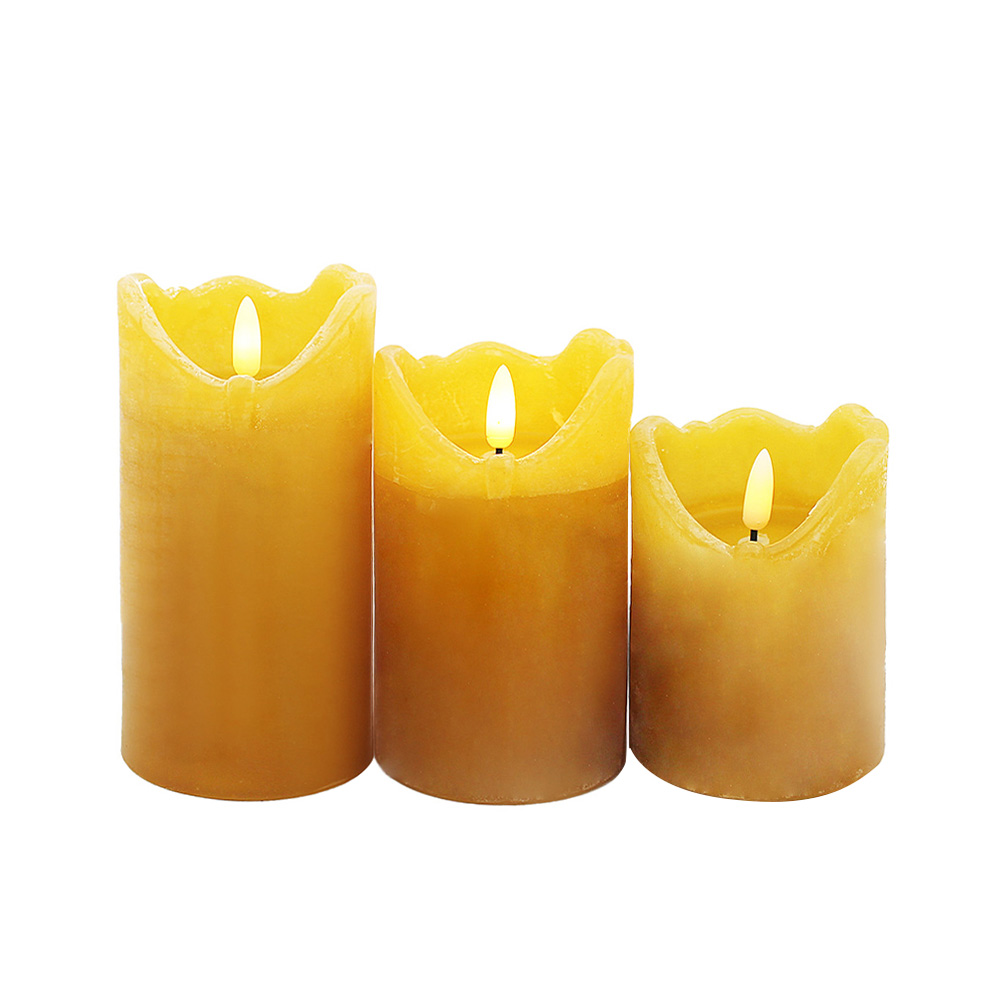
- Shell material: a 100% plastic shell with a printed wax texture is cheaper and lighter, but a real wax outer shell looks and feels better at retail. Real wax adds weight and shipping fragility, so the choice affects both cost and unboxing experience.
- Color temperature: warm white can drift from 2200K to 3000K between production batches. A disciplined factory bins its LEDs and records color temperature as a QC parameter.
For a closer look at how flicker patterns are reproduced, our technical analysis of flameless candle flame simulation explains the difference between pulse-width modulation and randomized flicker in practical terms.
 Glass Tube 3D Wick LED Pillar Candle with Realistic FlickerThis model exemplifies how precision-molded 3D wicks replicate flame dynamics. Reviewing it here clarifies the production steps that can introduce flicker defects.View Product →
Inside the Production Process: From Wax Shell to Finished Pillar
Every defect in an LED pillar candle can be traced to a stage in the production line. The flow below maps the typical sequence inside a factory that manufactures candles in-house.
Four stages deserve special attention during a factory audit:
- Shell molding: air pockets in the wax or plastic create weak points that crack during shipping.
- Soldering: cold joints on the battery wire cause intermittent shutdown that consumers describe as the candle randomly turning off.
- Calibration: untuned flicker makes adjacent candles flash in sync, which looks artificial on a dining table or mantle.
- Aging test: a 48-hour continuous burn is the minimum needed to catch early battery or controller failure before the product is packed.
The table below lists the QC checkpoints that a competent manufacturer should run on every batch.
| Checkpoint | What is verified | Typical pass criteria |
|---|---|---|
| LED color temperature | Warm white consistency | 2200-3000K target; batch deviation within 300K |
| Flicker pattern | Randomized flame motion | 2-4 Hz variation, no fixed pulse |
| Current draw | Battery drain at 3V | No more than 30 mA per candle |
| Timer accuracy | 6 h on / 18 h off | Within 15 minutes after 48 h aging |
| Remote range | IR or RF signal | At least 8 m in open area |
| Drop test | Shell structural integrity | No cracks after 1 m drop onto concrete |
| Aging test | 48 h continuous burn | No flicker dropout or thermal fault |
 Flameless LED Cylindrical Candle for Custom Bulk OrdersWith QC checkpoints in mind, this product page shows a versatile battery-powered design. Its multiple sizes and remote options make it a strong base for private-label inquiries.View Product →
Customization and OEM/ODM Capabilities
Most serious importers eventually want a specific size, a custom color, or a private label. A genuine factory controls its own tooling and assembly lines, so it can respond to these requests directly. A trading company must relay the request to a third-party factory, which adds weeks of communication and introduces ambiguity at every step.
Typical customization options in the LED pillar candle category include:
- Diameter and height, from small 3 x 6 cm votives to large 10 x 20 cm pillars
- Wax shell color: ivory, off-white, cream, or embossed multicolor patterns
- 3D wick shapes: flat flame, teardrop, rising flame, or jumping wick
- Light color: warm white, amber, RGB color shifting, or seasonal patterns
- Battery type: AA, AAA, or built-in rechargeable cells with USB charging
- Branding: debossed logo on the wax surface, printed base label, custom retail packaging
A factory that also produces other decorative LED shapes, such as columnar cement candles or glass lamps, can usually apply the same engineering workflow to a custom pillar candle. The process, from reviewing a drawing or sample to building a prototype and then ramping to bulk production, is identical across its product lines.
 Columnar Cement LED Candle with Custom Manufacturing OptionsThis cement-textured candle demonstrates the factory's wider molding capabilities. Its size and configuration choices directly influence the material and labor portions of your cost breakdown.View Product →
Cost Structure and the Port Advantage
Pricing for an LED pillar candle is a sum of materials, electronics, labor, overhead, and logistics. A typical breakdown at a Chinese manufacturing facility looks like this:
Materials dominate the cost, which is why factories that buy LED modules and batteries in large volumes can underprice smaller competitors without cutting quality. The electronics module is the second largest item, and it follows different cost curves than wax or plastic, so a quote that looks cheap per unit may use an older control board with a simpler flicker pattern.
Location creates another cost dimension. A factory near the Ningbo port can load full containers flexibly, reduce inland trucking, and shorten the time between the end of production and the vessel departure date. For a seasonal category like pillar candles, ten days saved in the supply chain can mean the difference between hitting a retail window and missing it.
Red Flags and a Practical Vetting Checklist
When you compare LED pillar candle manufacturers, walk away from suppliers that show these signs:
- The salesperson cannot provide a live video tour of the molding and assembly lines.
- The unit price is 20% below comparable quotes, but the supplier cannot explain where the saving comes from.
- There is no documented CE or RoHS certification available for review.
- The default battery type, LED color temperature, and timer setting are not clearly defined in the quotation.
- The supplier refuses to share photos of actual outgoing shipments and carton markings.
A reliable factory will present its standard product range first, then discuss customization. That sequence is a strong sign that the quotation is based on a real operating system, not on a spreadsheet built to win a tender.
Sourcing LED pillar candles is not a price-matching exercise; it is a process of verifying that the factory can actually produce what its catalog promises. Look at the molding line, the calibration station, the aging rack, and the QC records. When a manufacturer passes those checks, the rest of the conversation, including lead times, payment terms, and seasonal planning, becomes routine. That is the difference between importing a product and building a dependable supply chain.



Ningbo Weizhi Electronics Co., Ltd.
- We will be pleased to provide products with high quality, reasonable price, punctual delivery and best service for you!
GET A QUOTE
Building 2, No. 2477, Cihai North Road, Xipu Town, Zhenhai District, Ningbo City, China
-
 +86-18067520996
-
 +86-574-86561907
-
 +86-574-86561907
-
 [email protected]
- +8618067520996
- +86 18074202116
- WhatsApp: +86 18067161072

Copyright 2024 Ningbo Weizhi Electronics Co., Ltd. All Rights Reserved.
 Wholesale Outdoor Flameless LED Candles Manufacturers
