The Industrial Infrastructure and Strategic Output of Flameless Candle Manufacturing
A modern battery powered candles factory operates as an integrated, high-throughput manufacturing facility utilizing automated injection molding, precision optoelectronic assembly, and computerized paraffin-wax dipping lines to produce safe, energy-efficient flameless lighting instruments. Unlike traditional candle foundries that rely purely on thermal fuel combustion, these advanced industrial plants merge chemical wax formulation with semiconductor engineering. By standardizing manufacturing parameters across surface-mount technology (SMT) circuit processing and automated quality-assurance inspection bays, these factories deliver durable electronic decor assets that replicate the natural, chaotic flicker of an open flame while completely eliminating fire hazards, carbon soot emissions, and indoor air pollution.
In the global consumer goods and commercial hospitality sectors, the demand for sophisticated flameless illumination has escalated dramatically over the past decade. Commercial venues, such as high-density cruise ships, boutique hotels, and protected historical properties, maintain strict zero-flame fire safety regulations. To serve these volume markets, a dedicated battery powered candles factory must transition away from rudimentary manual assembly methods toward heavy industrial automation. The modern production landscape requires large-scale automated machinery that can process metric tons of synthetic polymers and raw paraffin wax daily, turning them into tightly sealed, drop-tested electronic devices.
The engineering footprint of these factories extends far beyond basic plastic molding into advanced micro-electronics and light-refraction science. The characteristic realism of premium flameless candles is achieved by programming application-specific integrated circuits (ASICs) that modulate LED voltage inputs alongside physical electromagnetic pendulums that sway under light electromagnetic currents. Understanding the mechanical, chemical, and optical systems deployed across the production floor is essential for evaluating product durability, factory efficiency, and the supply chain dynamics of contemporary consumer electronics.
Mechanical Layout and Workflow Architecture of the Production Floor
An optimized factory layout relies on a unidirectional linear assembly architecture designed to minimize raw material handling and eliminate cross-contamination between the electronic assembly zones and the thermal wax processing bays. The manufacturing floor is strictly segmented into four main operating sectors, each maintained under localized climate and particulate controls.
Sector 1: Injection Molding and Core Shell Fabrication
The structural journey of an electronic candle begins in the heavy plastics section. High-pressure hydraulic injection molding machines, operating with clamping forces between 150 to 300 metric tons, melt raw pellets of Acrylonitrile Butadiene Styrene (ABS), Polypropylene (PP), or Polycarbonate (PC). The liquified polymer is injected into multi-cavity tool steel molds at temperatures ranging from 220°C to 260°C to form the internal structural chassis, battery compartments, and structural top-caps of the candles.
For frosted or outdoor-grade variants, plastic pellets are mixed with specialized ultraviolet (UV) stabilizing masterbatches and precise ratios of diffusing agents. This compound formulation ensures that when the internal LED shines through the finished plastic wall, the light undergoes uniform scattering, preventing the hot-spotting effect where the shape of the bare bulb becomes visible to the end user.
Sector 2: Electronic Circuit and Surface Mount Technology Assembly
Concurrently, the electronic brain of the device is assembled in an anti-static, cleanroom-standard environment. High-speed automated SMT pick-and-place lines deposit solder paste onto printed circuit boards (PCBs) before populating them with surface-mount resistors, infrared (IR) receivers, timing crystals, and microcontroller units (MCUs). The populated boards pass through multi-zone reflow ovens to solidify the solder joints at controlled thermal gradients.
The firmware flashed onto the MCU at this stage contains the algorithmic code that governs the flame simulation. Rather than using a simple binary on-off cycle, the controller applies a Pulse Width Modulation (PWM) duty cycle ranging from 5% to 100% based on a pseudo-random number generator sequence. This algorithmic variation causes the LED's luminous intensity to shift non-periodically, mimicking the behavior of natural combustion flame currents.
Advanced Chemistry of Real-Wax Coating and Finishing Systems
To cater to premium retail markets, a major section of a battery powered candles factory is dedicated to outer wax processing. Merging an authentic tactile feel with internal electronics requires strict chemical balancing of the wax blend to prevent shrinkage, cracking, or melt-deformation when exposed to high ambient temperatures during international shipping container transit.
The raw material base consists of high-melting-point fully refined paraffin wax mixed with 10% to 15% stearic acid and specialized polymer hardeners. The addition of stearic acid increases the candle's overall structural density and opacity, while lifting the final melting point of the blended compound to approximately 62°C to 65°C. This chemical modification ensures that the finished candle can withstand harsh storage conditions in non-air-conditioned warehouses without losing its shape or weeping oil.
The application of the wax surface is managed by automated multi-station dipping conveyors:
- The injection-molded ABS plastic cores are mounted onto overhead mechanical robotic claws traveling along a continuous rail system.
- The plastic cores are submerged into temperature-controlled, agitated wax vats maintained at precisely 78°C (±0.5°C) for a calculated duration of 3.2 seconds.
- The cores are lifted into an active cooling tunnel filled with chilled air operating at 12°C to solidify the initial wax layer.
- The dipping cycle is repeated up to three times until a uniform outer wax wall thickness of 2.5mm to 3.5mm is established around the structural core.
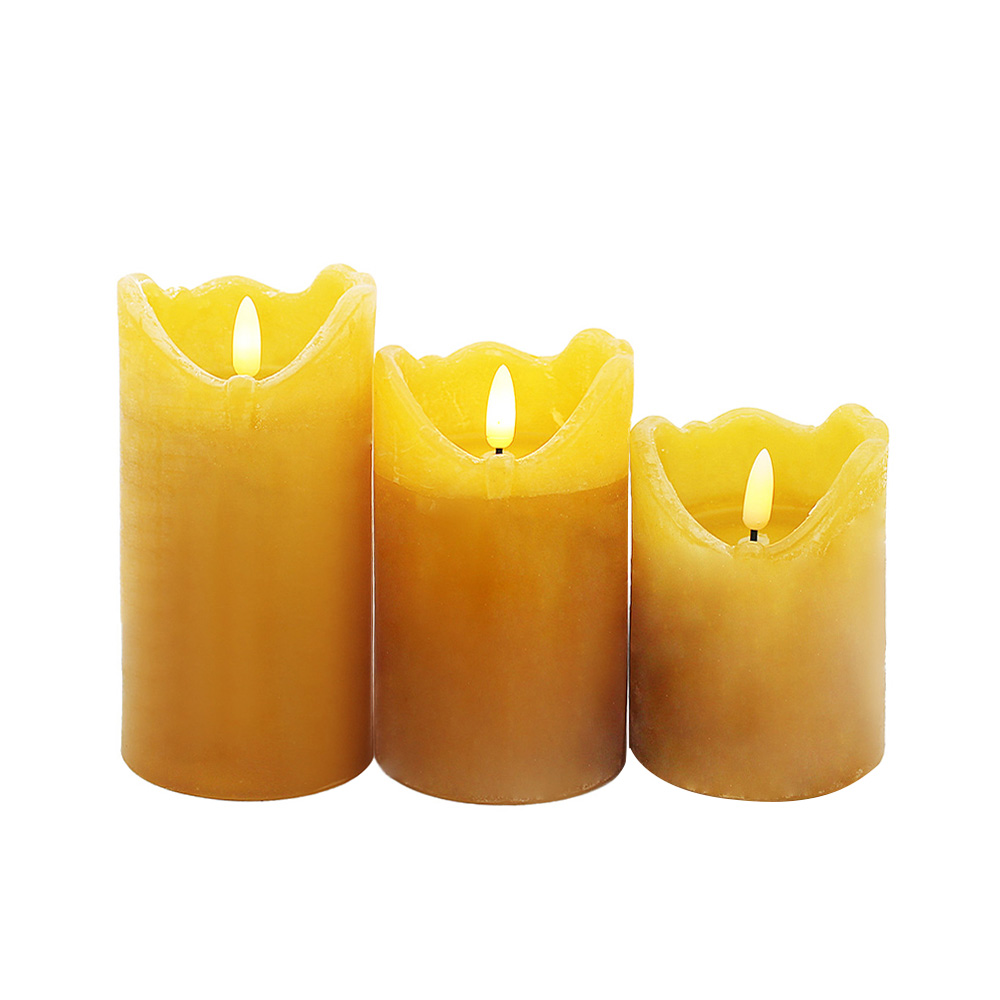
Once cooled, the wax-covered cylinders are routed through automated hot-air sculpting bays. Computer-controlled heating elements pass over the top rim of the candle for a split second, partially melting the crisp edge to create a natural-looking "melted pool" or a rustic wavy edge profile, ensuring that no two candles leaving the line look identical.
Kinematics and Optics of Moving Flame Simulation Technologies
The visual center of a high-end flameless candle is its physical moving wick system. The mechanical implementation of this system governs how light reflects into the surrounding environment, distinguishing budget-tier products from premium lifelike simulations.
The moving flame module relies on a balancing pendulum made from a lightweight, flame-shaped die-cut plastic sheet coated with a high-reflectivity matte finish. This plastic flame element is hung on a micro-fine stainless steel pivot pin inside the candle's neck, allowing it to swing freely in two dimensions. Below the pivot point, a tiny permanent neodymium magnet is attached to the base of the pendulum rod.
Directly beneath this magnetic assembly sits an copper wire electromagnetic coil connected to the candle's control circuit. As the microprocessor sends low-voltage electrical pulses to the coil, it generates a shifting, low-intensity magnetic field that repels and attracts the pendulum's magnet. This magnetic interaction causes the plastic flame piece to dance and sway continuously.
Simultaneously, a focused, angled surface-mount LED positioned inside the candle chassis projects a concentrated beam of warm light (typically at a color temperature of 2400K to 2700K) upward onto the moving plastic pendulum. As the pendulum sways randomly, the projected light bounces off its shifting surface angles, casting moving shadows and reflections onto nearby walls, capturing the natural visual movement of an organic combustion flame.
Comparative Technical Parameters of Flameless Candle Architectures
Industrial product engineers choose specific candle designs based on the targeted retail pricing structure, intended battery life, and environmental placement. The table below compares the performance profiles of standard architectures manufactured inside a battery powered candles factory.
| Candle Technology Profile |
Average Current Draw (mA) |
Expected Runtime (2x AA Alkaline) |
Visual Realism Classification |
Primary Operational Environment |
| Moving Wick Electromagnetic Pendulum |
12mA - 18mA |
150 - 220 Hours |
Premium (Maximum realism) |
Indoor Residential / High-End Hospitality |
| Stationary 3D Textured Wick (Flicker LED) |
6mA - 9mA |
300 - 450 Hours |
High (Stable close-up view) |
Standard Indoor Decorative Collections |
| Flat-Top Embedded LED (Resin Pool) |
4mA - 6mA |
500 - 700 Hours |
Moderate (Best seen from afar) |
Mass Catering / Event Center Tables |
| Waterproof Fully Sealed Plastic Shell |
7mA - 11mA |
250 - 350 Hours |
Moderate (Focuses on sealing) |
Outdoor Patios / Wet Landscape Lighting |
Operational performance matrix comparing battery consumption against visual fidelity parameters across primary production classifications.
The technical metrics show that while moving wick electromagnetic systems consume more current due to driving both an inductive coil and an optical LED, they deliver premium realism. To extend operational runtimes on these high-draw configurations, factory engineers build in automated 4-hour or 24-hour sleep cycle timers within the microcontroller code, allowing the device to conserve battery capacity over weeks of automated operation.
Quality Control Testing Frameworks and Failure Analysis
To maintain high yields and minimize retail return rates, modern factories implement rigorous testing protocols. Electronic candles must function reliably after experiencing physical impacts, voltage drops, and severe environmental shifts during global distribution.
Automated Optical Inspection and Luminous Binning
After passing through the final electronics line, every circuit module is placed inside an automated optical inspection chamber. High-resolution digital cameras check component alignment and solder bead volume, while integrated spectrometer sensors analyze the light output of the active LED.
LEDs that deviate from the strict warm-white coordinate boundaries—falling into greenish or cold blue spectrums—are flagged and separated. This luminous binning process ensures that when a consumer displays a multi-piece candle set on a single mantelpiece, all units glow with identical color rendering indices, preventing jarring variations in lighting quality.
Mechanical Stress and Drop Simulation Testing
Random samples from every production lot are routed to the mechanical destruction lab. Here, candles are mounted into a motorized tumbling barrel that simulates repeated drops from a height of 1.0 meter onto a hard concrete base. Following the test, technicians inspect the internal component brackets and solder connections.
The primary failure mode analyzed is the fracture of the thin wire leads connecting the battery terminal springs to the main PCB. Using reinforced solder anchors and flexible, multi-strand silicone-insulated copper wiring prevents these vibration failures, ensuring the product can withstand rough handling by shipping couriers and consumers alike.
Apparel Industrialization: Scaling Packaging and Logistics Management
The final phase of factory operations covers precision packing and logistical transit protection. Because premium real-wax flameless candles are susceptible to both scratching and thermal warping, packing processes must utilize specialized structural shielding.
Phase 1: Surface Scratch Mitigation and Film Application
As the finished candles emerge from the cooling tunnels, automated robotic arms apply a micro-thin, electrostatic polyethylene film around the outer wax perimeter. This film protects the soft paraffin layer from scuffs, fingerprints, and friction damage caused by contact with automated sorting guide rails, keeping the exterior finish pristine during final boxing.
Phase 2: Structural Tray Thermoforming and Vibration Isolation
The candles are placed into custom-molded thermoformed trays made from high-density polyethylene (HDPE). These trays feature individual recessed cavities that support the candles at their structural ABS base and top rim, keeping the delicate moving wicks suspended in free air. This isolation prevents the wicks from contacting the box walls, protecting the sensitive internal pivot pins from bending or snapping during rough transit.
Phase 3: Environmental Integration Testing
Packed product cartons are subjected to environmental stress testing inside specialized walk-in simulation chambers.
- Load the master product cartons into the environmental testing chamber.
- Ramp the internal chamber temperature to 55°C while maintaining relative humidity at 85% for a continuous 48-hour testing block.
- Unpack the sample cartons and evaluate them for structural wax melting, deformation, or chemical separation of the battery compartment seals.
Phase 4: Sealed Palletization and Thermal Blanket Insulation
Once validated, the individual retail boxes are packed into heavy-duty corrugated shipping cartons and stacked onto industrial pallets. Automated orbital wrapping machines encase the pallets in heavy-gauge stretch wrap, and for long-distance maritime shipping, a layer of reflective thermal insulation foil is wrapped around the exterior. This insulation blocks radiant heat inside steel shipping containers, preventing the candles from melting during transit through tropical shipping routes and ensuring the product arrives in perfect condition.
Sustainability Initiatives and Hazardous Substance Compliance
As environmental regulations tighten globally, the battery powered candles factory landscape is undergoing a significant transition toward ecological sustainability. Because these products combine electronic components with large volumes of polymers, manufacturers must address end-of-life disposal and hazardous substance management.
To enter strict European and North American retail markets, production lines must comply fully with the Restriction of Hazardous Substances (RoHS) Directive. This compliance requires factories to use lead-free solder pastes in their SMT reflow ovens and eliminate heavy metal stabilizers, such as cadmium or hexavalent chromium, from their injection molding plastic resins. This focus ensures that the internal electronics do not leach toxins into landfill environments at the end of their operational lifespans.
Additionally, forward-thinking factories are replacing petroleum-derived paraffin wax with 100% biodegradable hydrogenated soy wax and beeswax compounds. Soy-based coatings significantly reduce the factory's carbon footprint while offering a lower natural melting point that requires less energy during the automated dipping phases. By combining these renewable plant waxes with post-consumer recycled ABS plastics for the internal chassis, factories can produce eco-friendly flameless lighting collections that appeal to environmentally conscious consumers without sacrificing structural durability or optical performance.



 English
 Deutsch



 +86-18067520996
 +86-574-86561907
 +86-574-86561907
 [email protected]

 Wholesale Outdoor Flameless LED Candles Manufacturers
