


 English
 Deutsch
Rechargeable Flameless Candles: Applications, Selection Criteria, and Practical Guidance
Five hours a night, seven nights a week, works out to roughly 1,800 lit hours a year from a single candle position. That one figure settles most rechargeable-versus-disposable arguments before price even enters the conversation: rechargeable flameless candles pay off when the same fixture stays in service month after month and the display is refreshed nightly. Disposable battery candles still win for short seasonal windows, hard-to-reach outdoor placements and one-off events where nobody wants to manage chargers.
The notes below come from the production side of that decision — what changes on the spec sheet, what it actually costs to charge ninety units overnight, and which paperwork a lithium-powered candle needs before it can leave the factory.
The Reuse Math: Where Rechargeable Pays Back
Treat 40 to 60 charge cycles as the crossover point. Below that, a rechargeable unit rarely recovers its higher purchase price; above it, the savings come less from battery cells and more from handling time and disposal.
Take a venue with 90 table candles that swaps alkaline cells every ten days. Each swap costs 40 to 90 seconds per unit once collection, base opening, cell sorting and reassembly are counted, so one round consumes one to two hours of staff time — four to seven hours a month. A rechargeable set with a ten-port tray cuts that to 10 to 20 seconds per unit, because units travel from table to tray and back without ever being opened.
Cell cost is the smaller line item. A 3xAA pillar delivers roughly 200 to 300 hours per set, so 500 lit hours consume about six cells at around $0.30 each. Recharging an equivalent lithium pack for the same 500 hours draws a few cents of electricity. Across 90 positions the annual difference is noticeable, but the labour difference is typically three to five times larger.
| Consideration | Disposable alkaline | Rechargeable (built-in Li-ion) |
|---|---|---|
| Upfront unit cost | Baseline | 20–60% higher |
| Consumables per 500 lit hours | About 6 AA or AAA cells | None |
| Runtime per set or charge | 200–300 h (pillar) | 20–60 h (pillar) |
| Turnaround after depletion | Instant swap | 3–8 h recharge |
| Handling per refresh | 40–90 s | 10–20 s with a dock |
| Added weight per unit | — | 20–40 g |
| Cold performance | Output sags below 0 °C | Charge only at 0–45 °C |
| Shipping paperwork | None | UN38.3 plus test summary |
| End of life | Cell waste every few weeks | 300–500 cycles, then e-waste |
| Best fit | Short seasons, remote spots | Nightly venues, rentals, staged sets |
Illustrative cost per 1,000 lit hours — 3xAA pillar candle
Four Charging Interfaces and What They Cost You
For hospitality, rental and staged retail use, USB-C is the safest default and a magnetic pogo-pin base is the fastest. Both fail in the same place: the point where moisture meets metal.
- USB-C port under the base. Standard cable, cheapest to support, easy for hotels that already stock USB-C chargers. The port is the weak link — without a silicone plug or a recessed housing, dust and damp kill it inside a season.
- Magnetic pogo-pin base. Drops onto a puck or cable and charges with no visible opening. Fastest for staff, but pins corrode in humid rooms and the magnet collects steel cutlery on a dining table.
- Multi-unit charging tray. Ten to twenty sockets on one tray fed by a single power supply. Best handling time of the four, highest tooling cost, and it locks the buyer into one base geometry for future orders.
- Inductive charging coaster. Fully sealed with no contacts, which suits bathrooms and covered terraces. Slowest to charge, and coil alignment must be forgiving or units sit overnight without taking any charge.
Specify charge management rather than charging alone: overcharge and over-discharge protection, a 5V/1A input ceiling so a 30W phone charger cannot cook the board, and cells shipped at 30 to 50% state of charge. A three-position switch — on, off, 6-hour timer — removes the most common complaint in this category, which is a unit found dead after a weekend of nobody switching it off.
Typical charge time from empty by interface
Judging a 3D Wick in Ten Minutes
Flame realism is where inexpensive units expose themselves, and the test is quick. Stand a sample on a table, dim the room, then look at it from one metre and again from three. A well-tuned 3D wick produces a soft-edged flame that wanders without repeating; a poor one snaps back to the same position on a fixed cycle that becomes obvious within a minute.
- Colour temperature. 1,800–2,200 K reads as candlelight; anything above 2,700 K looks like a flashlight behind wax.
- Hot spot. The brightest point should sit just above the wick, not at the tip of the shell.
- Wall translucency. A thin, even wax wall glows uniformly; thick corners show dark rings.
- Wick tip. A matte black tip with a faint glow at its base; glossy plastic tips look wrong at arm's length.
- Seams and parting lines. Should be invisible on a candle that sits on a dining table.
- Low-battery behaviour. A good driver holds the flame steady down to cut-off instead of letting it stutter.
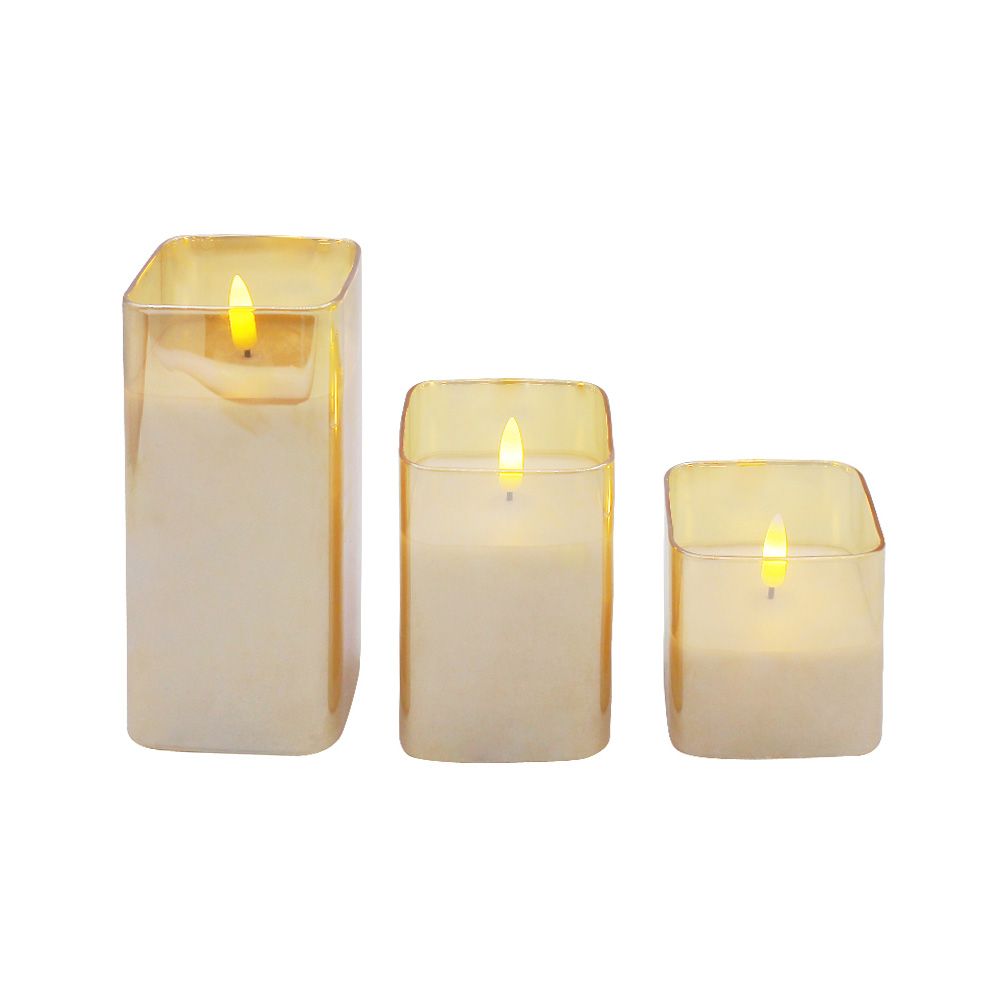
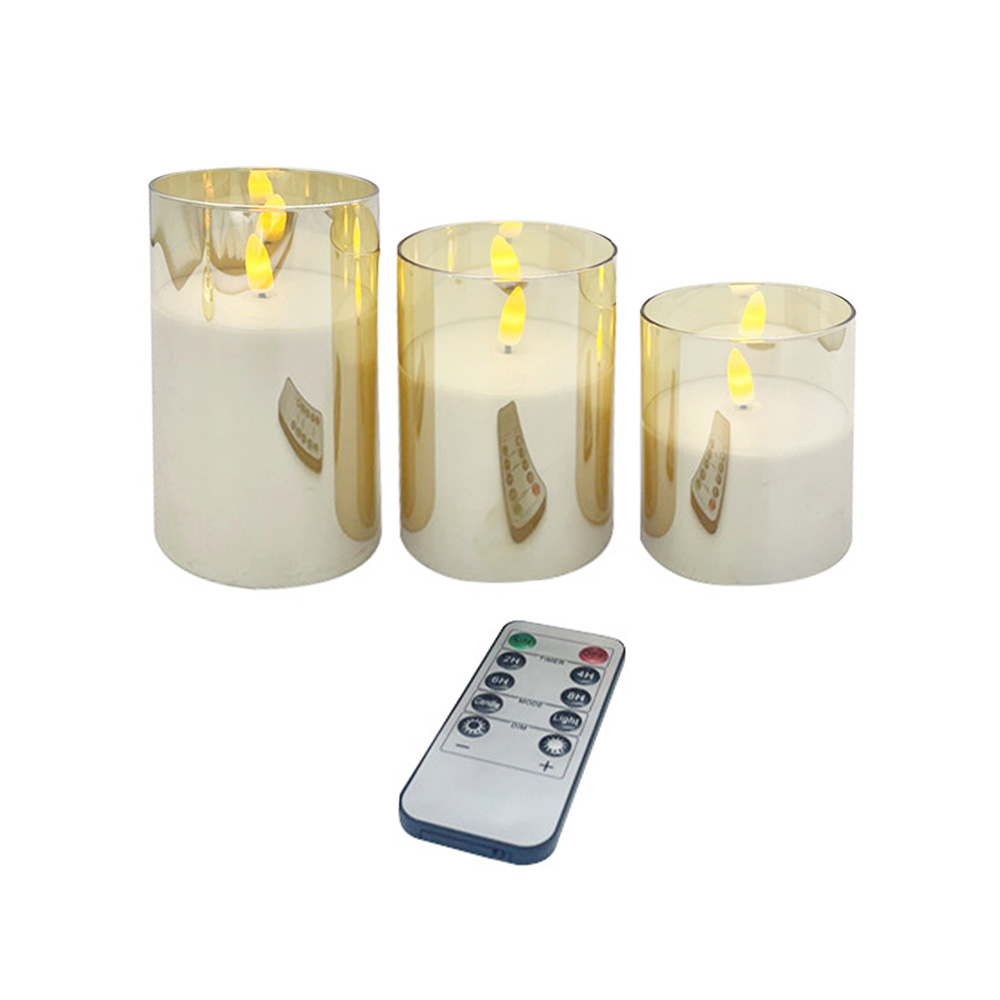
 Glass Tube 3D Wick LED Pillar CandleTransparent glass tube and 3D wick create a soft flickering flame; optional timer and remote support multi-unit setups.View Product →
Controls That Decide Repeat Orders
Remotes in this category usually run at 433 MHz, and the practical question is channel pairing: when forty candles sit on forty tables, one press must not switch on the whole room. Ask for paired remotes or per-unit addressing, confirm whether the timer stores its setting through a power cut, and check that dimming steps are gradual enough to avoid a visible jump between levels.
Compliance and Lithium Paperwork
A rechargeable candle is legally a piece of equipment containing a lithium-ion cell, and that reclassification changes the paperwork. Ship it without the battery documents and the carton stops at the airport, whatever the CE marking on the box says.
Documents a rechargeable candle shipment needs
- Destination market
- EU: CE marking — EMC, RoHS, REACH; LVD only when a mains adapter is included
- UK: UKCA on the same technical file
- US: FCC Part 15 for units sold with a remote control
- Battery and transport
- UN38.3 test summary naming the exact cell and pack model
- MSDS or SDS for the cell chemistry
- Packing instruction PI 967 (UN3481) for equipment containing lithium-ion cells
- Drop test record from the cell report
- Factory quality records
- IEC 62133-2 pack safety report
- Overcharge, over-discharge and charge-temperature cut-off data
One detail catches buyers out: the UN38.3 summary must name the cell and pack model, not just the finished candle. If a supplier changes cell brands between orders, the summary has to be reissued. Put the report number on the purchase order so incoming inspection can match it. Our certificates page lists the CE and RoHS documentation we hold; transport papers are issued per order because the cell model can change.
Materials, Weight and Ingress Protection
Shell material decides how a rechargeable candle ages, and it also decides freight cost. The four options below cover most of what ships today.
| Shell | Visual effect | Weight | Outdoor behaviour | Handling notes |
|---|---|---|---|---|
| Real wax | Best flame diffusion | Medium | Softens above 40 °C; keep shaded | Scratches; dust clings to the surface |
| Cement | Matte, industrial texture | Heaviest | Needs a sealed base and IP44 minimum | Edges chip; freight cost rises fast |
| Glass | Reflective, premium look | Medium to heavy | Trapped moisture fogs the interior | Fingerprints; breakage risk in transit |
| Plastic or resin | Widest shape range | Lightest | UV yellowing after a season or two | Mould seams visible at close range |
For outdoor use, IP44 covers a sheltered porch and IP65 is the realistic minimum for an exposed terrace; the charge port or contact plate is almost always the first point of failure, so a gasket there matters more than the shell rating. Weight deserves more attention than it usually gets: a 600 g cement pillar across 5,000 units is three tonnes of freight, and drop damage climbs with it.
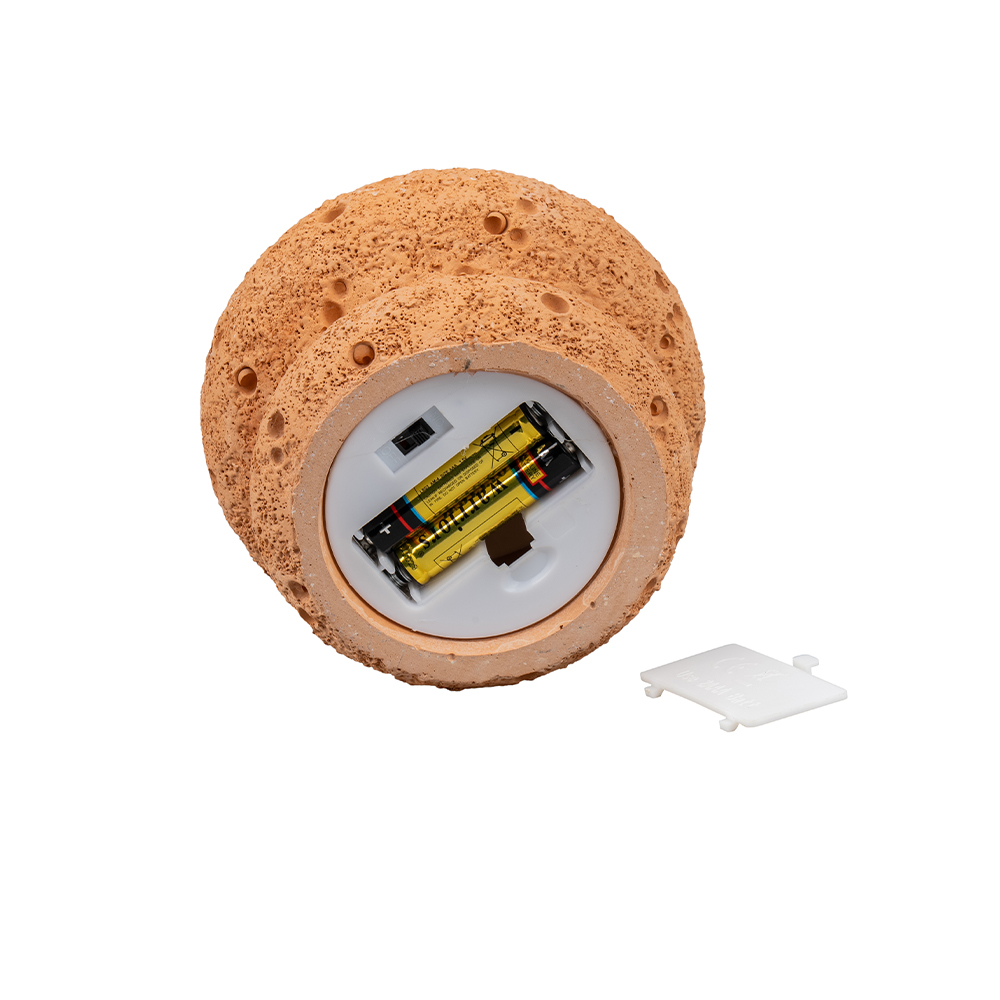 Waterproof Outdoor Cement LED Flameless CandleWaterproof cement-bodied 3D LED candle for outdoor tables, with battery operation, timer, and 11 x 7 cm size for fit checks.View Product →
Formats, Fit and the Spec Sheet
Most returns in this category are fit problems rather than electrical ones. Taper candles need an 18–22 mm base to sit in a standard holder without wobble, votives must drop into a 50 mm cup, and pillars are usually specified by diameter and height in inches because that is how buyers plan a display layout.
 Remote-Control Flameless LED Taper Stick CandleSlim 2.2 x 24 cm taper with 3D wick and remote/timer control; check base fit and repeat-order battery and colour consistency.View Product →
| Parameter | Target | Tolerance to accept |
|---|---|---|
| Overall dimensions | As drawn, e.g. 75 x 150 mm | ±1 mm |
| LED colour temperature | 1,800–2,200 K | ±200 K |
| Flame pattern | 3D wick, random flicker | No visible fixed cycle in 60 s |
| Runtime per charge | 30 h at medium brightness | ±10% |
| Charge time | 6 h or less from empty | USB-C 5V/1A input |
| Battery | 1,200 mAh protected Li-ion | 300 cycles to 80% capacity |
| Charge temperature | 0–45 °C | Cut-off outside the range |
| Ingress protection | IP44 covered, IP65 exposed | Gasket on port and seam |
| Switch logic | On / off / 6-hour timer | No activation inside the carton |
Before You Place the Order
Three questions separate a smooth programme from a difficult one. First, does the supplier hold the same cell model across repeat orders, since every cell change triggers new battery paperwork. Second, are charging cables, trays and spare bases available as line items, because a dock that fails with no replacement strands the whole set. Third, how is colour matched between batches — wax and cement both shift tone from lot to lot, and a second shipment that reads warmer than the first is a visible problem in a guest-facing room.
We build flameless candles in wax, cement, glass and plastic at our factory in Ningbo, and we quote rechargeable configurations against a drawing or a physical sample, since port placement, base geometry and cell choice all depend on the shell. Our sourcing guide walks through the RFQ stage in more detail. Send dimensions, runtime target and destination market, and the battery and compliance path becomes clear before tooling is committed.


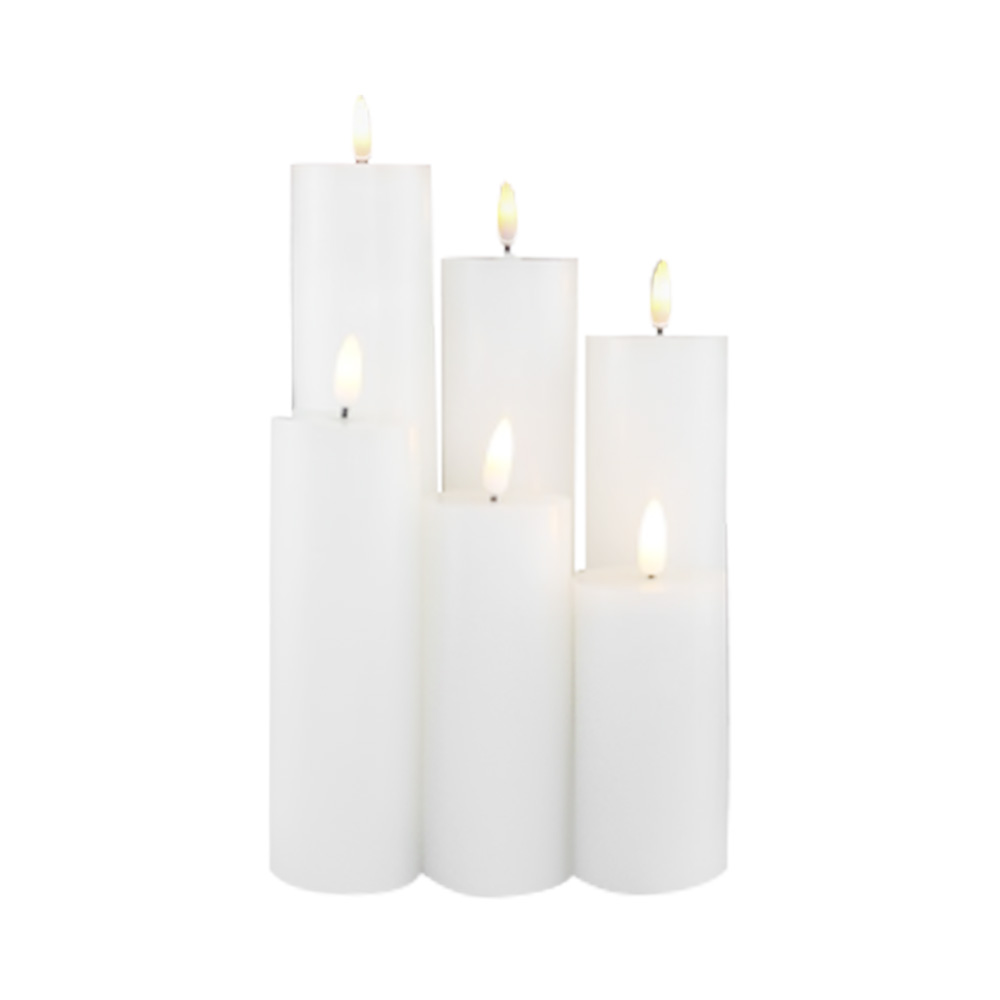
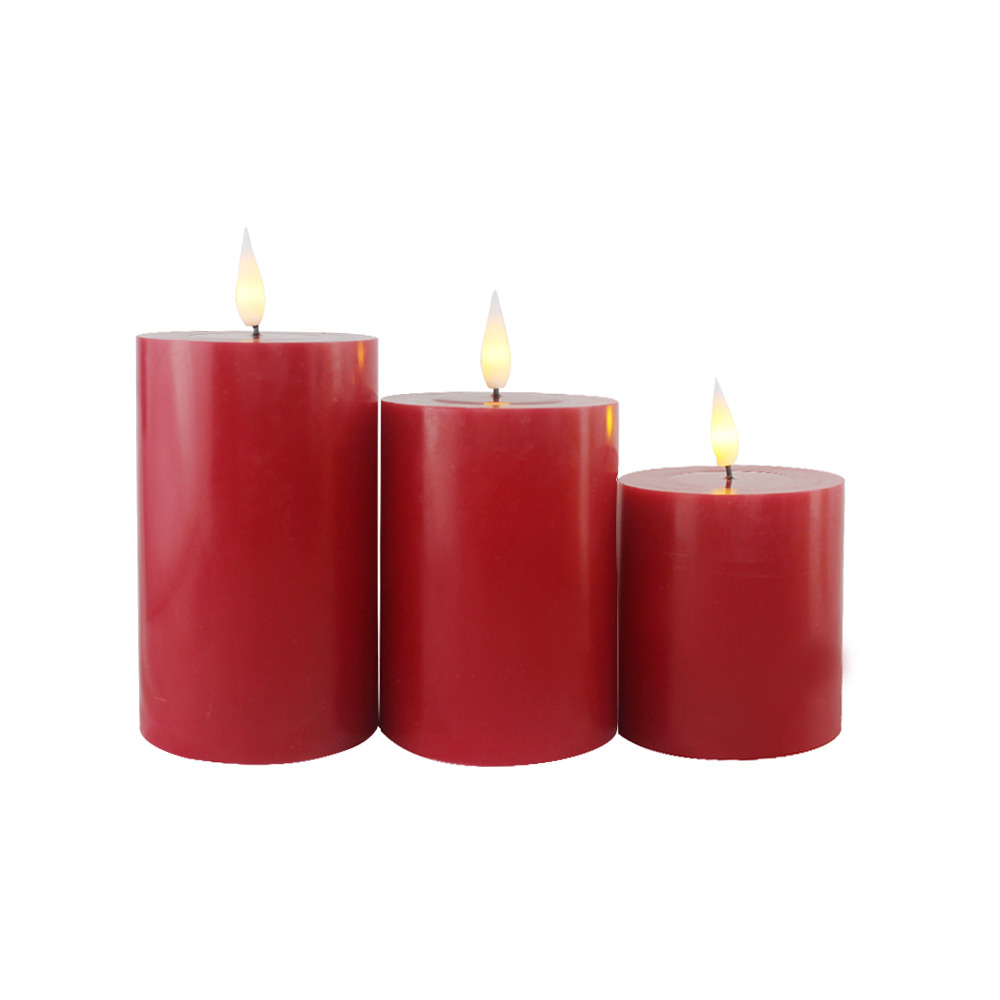

Ningbo Weizhi Electronics Co., Ltd.
- We will be pleased to provide products with high quality, reasonable price, punctual delivery and best service for you!
GET A QUOTE
Building 2, No. 2477, Cihai North Road, Xipu Town, Zhenhai District, Ningbo City, China
-
 +86-18067520996
-
 +86-574-86561907
-
 +86-574-86561907
-
 [email protected]
- +8618067520996
- +86 18074202116
- WhatsApp: +86 18067161072

Copyright 2024 Ningbo Weizhi Electronics Co., Ltd. All Rights Reserved.
 Wholesale Outdoor Flameless LED Candles Manufacturers
